
Why You Should Never Use KeyDB as a Pub/Sub Broker for Centrifugo
KeyDB's active-replica mode looked perfect for a symmetric dual-stack chat at 100K WebSocket connections. Then I found five years of hang and deadlock issues, most still open.
On this page
- Introduction
- 1 The Problem
- 2 Why This Is Catastrophic for Centrifugo
- 3 Evaluating Alternatives
- 4 Building It
Valkey Primary + Replica + Sentinel (3-Node Quorum)
Architecture ChangeThe Hard Part: Docker Networking vs. SentinelMinimal Configuration Changes - 5 Validation
- Conclusion
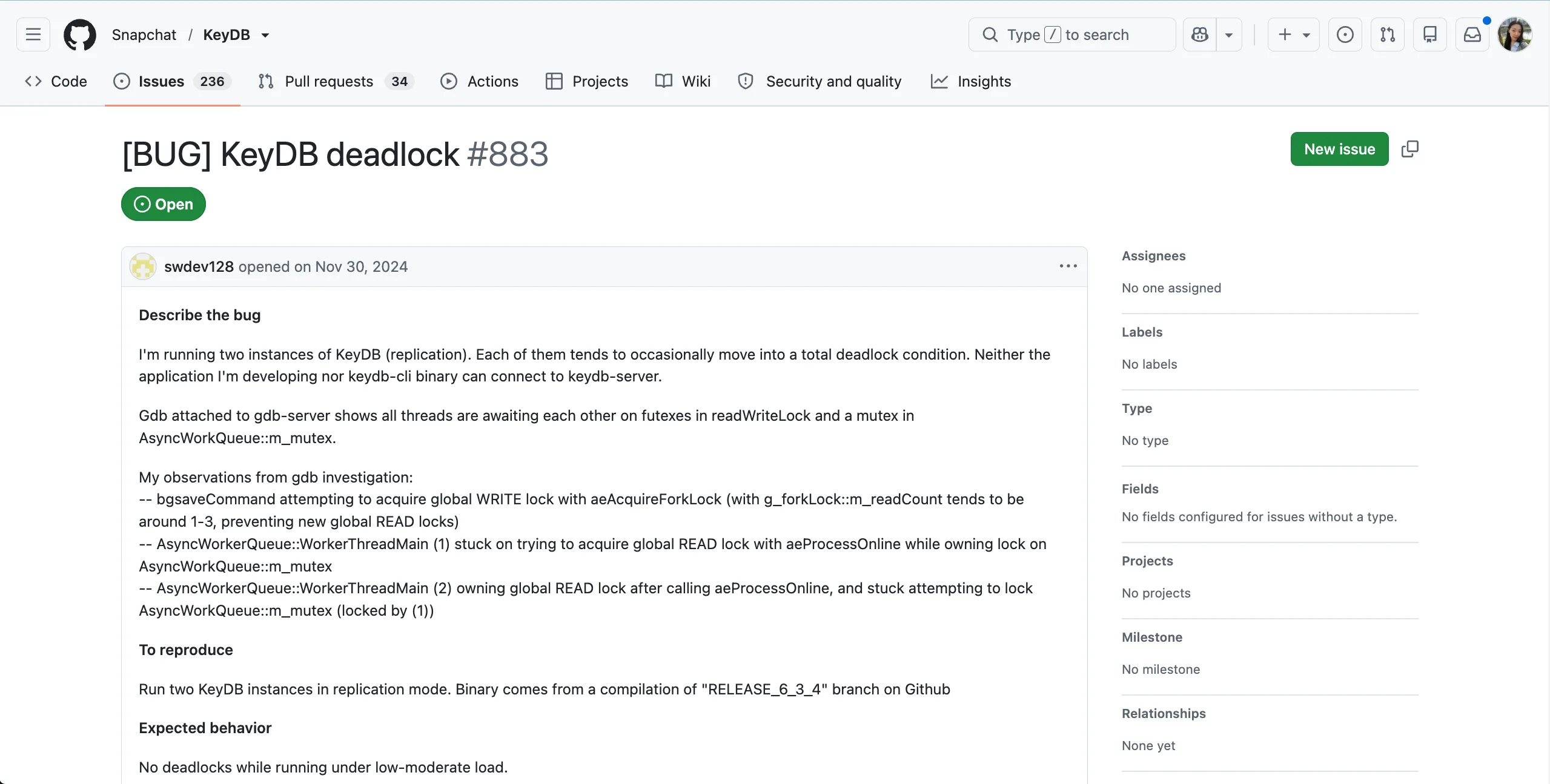
Reference: Snapchat/KeyDB #883 — KeyDB deadlock
Introduction
I was building a real-time chat system designed to handle 100K concurrent WebSocket connections at 25K+ messages per second. The architecture was a symmetric dual-stack — two identical servers (16 vCPU / 58 GB each) running 5 Centrifugo nodes apiece, with Cloudflare DNS splitting traffic 50/50.
The critical challenge was cross-server message synchronization. When a user connected to Server A sends a message, it must reach a user on Server B. Centrifugo delegates this to Redis Pub/Sub — whichever Redis-compatible store sits behind it becomes the backbone of the entire messaging pipeline.
I chose KeyDB. It was a multithreaded Redis fork with active-replica mode, allowing bidirectional writes. Server A and B could both write, and changes would sync automatically. It looked perfect for a symmetric architecture.
Server A: KeyDB Primary (read/write) ↕ (bidirectional replication)Server B: KeyDB Active-Replica (read/write)Early load tests hit 23.6K TPS. Everything seemed fine.
Then I started reading GitHub Issues.
1. The Problem — 5 Years of the Same Bug
I began auditing KeyDB’s issue tracker before production deployment. What I expected to find were old, resolved bugs. What I actually found was a pattern that spanned half a decade.
A Timeline of Hangs and Deadlocks
| Date | Issue | Symptom | Status |
|---|---|---|---|
| 2019.11 | #103 | deadlock & hang | Closed (version upgrade) |
| 2023.03 | #619 | active-replica hang | Open |
| 2024.03 | #794 | full server hang | Open |
| 2024.06 | #845 | Pub/Sub freeze | Open |
| 2024.10 | #878 | KEYS command hang | Open |
| 2024.11 | #883 | replication deadlock | Open |
From 2019 to 2024, the same category of hang/deadlock kept recurring. And the latest version, v6.3.4, had not fixed any of them.
Structural Flaw: Multithreaded Deadlock
Issue #883 was the most alarming. It wasn’t a simple bug — it was a structural flaw in KeyDB’s multithreaded architecture itself.
bgsaveCommand attempts to acquire global WRITE lock ↓AsyncWorkerQueue thread(1): waiting for global READ lock, holding m_mutex ↓AsyncWorkerQueue thread(2): holding READ lock, waiting for m_mutex ↓→ 3-way deadlock → CPU usage drops to 0% → All client connections unresponsive → Does not respond to SIGTERM (only SIGKILL works)The entire server goes silent. No automatic recovery is possible. In Issue #845, users reported that even sudo reboot would hang — a hardware-level hard reboot was required.
A Project Effectively Abandoned
The last release, v6.3.4, was in October 2023. I was evaluating this in February 2026 — over two years with no updates. 233 open issues had accumulated on GitHub. Maintainer responses had virtually ceased since 2024.
I recalled what antirez, the creator of Redis, once said: “The risk of bugs in threaded code is very high, and Redis’s non-threaded architecture is a design for stability.”
2. Why This Is Catastrophic for Centrifugo
Centrifugo uses Redis Pub/Sub as the core path for inter-node message delivery. This isn’t a cache layer. It’s not a nice-to-have. If Pub/Sub freezes, every single Centrifugo node loses its ability to relay messages.
When KeyDB Pub/Sub freezes: ├─ Inter-node message delivery: completely halted ├─ All 10 Centrifugo instances: unable to deliver messages ├─ 100K connected users: total loss of real-time functionality └─ KeyDB ignores SIGTERM → no automatic recovery → An operator must manually hard-reboot the serverThe Centrifugo documentation explicitly states: “KeyDB compatibility in future releases is not guaranteed.” Every company running Centrifugo in production that I could find — VK, Badoo, ManyChat, Grafana — was using Redis or Redis + Sentinel. Not a single production deployment used KeyDB as a Pub/Sub broker.
3. Evaluating Alternatives — DragonflyDB vs. Valkey
KeyDB had to go. The question was what to replace it with.
DragonflyDB — Better Multithreading, But…
DragonflyDB is designed from the ground up as a multithreaded, shared-nothing architecture. Per-shard independent threads with minimal locking. The global lock contention that causes KeyDB’s deadlocks simply cannot occur structurally. When deadlock issues are reported, a full-time team patches them within days to weeks.
But Centrifugo doesn’t officially test against DragonflyDB. And there was a more fundamental question to ask.
Does Pub/Sub Even Need Multithreading?
For multithreading to provide any benefit, there’s a prerequisite: a single core must be hitting 100%. The entire point of multithreading is distributing work across cores because one core can’t keep up. So the real question is — when used as a Pub/Sub broker for Centrifugo, would Valkey’s single-threaded design ever saturate one core?
The Centrifugo official benchmark shows that at 1 million WebSocket connections delivering 500K messages per second, each Redis instance used roughly 5% CPU. The developer himself stated: “I handled 500K connections with 10 Centrifugo nodes + 1 Redis instance, and Redis used only 60% of a single core.”
Our environment is 100K connections. Proportionally, that’s about 12–15% of a single core. On a 16 vCPU server, that’s under 1% of total capacity. Pub/Sub simply relays messages — it’s one of the lightest workloads Redis handles.
CPU load by Redis workload type:
GET/SET cache (hundreds of K ops/sec)   ████████████████  ← heavyLPUSH/RPOP queue (bulk processing)      ██████████████    ← heavySorted Set operations (ranking/analytics) ████████████    ← heavyPUBLISH/SUBSCRIBE (message relay)       ███               ← light
But here’s the critical insight. Let’s say, for the sake of argument, that traffic spikes and Valkey’s single core reaches 60%. Should the response be “switch to a multithreaded database”?
No. Just add another Valkey instance.
Centrifugo natively accepts Redis addresses as an array. When configured this way, it applies consistent hashing on channel names and automatically distributes traffic. This isn’t Redis Cluster — the Valkey instances don’t even know about each other. Centrifugo handles the routing: “this channel goes to A, that channel goes to B.”
// Before: 1 Valkey instance — single core at 60%{ "address": "redis://valkey-a:6379" }
// After: 2 Valkey instances — each core at 30%{ "address": [    "redis://valkey-a:6379",    "redis://valkey-b:6379"  ]}
One line added to the config, and the load is halved. Three instances, one-third each. Linear horizontal scaling.
Here’s what this means:
When is multithreading needed?  = When a single core reaches 100%
What actually happens with a Pub/Sub broker:  Valkey's single core reaches ~60%  → Add one more Valkey instance, add one address to Centrifugo config  → Each instance now handles ~30%  → A single core never reaches 100%  → The situation that requires multithreading simply never arrives
Instead of breaking the single-core ceiling with multithreading, you deploy multiple single-core instances. This is safer, more predictable, and the industry standard. And since Centrifugo supports this natively — there’s no reason to use multithreaded Redis variants like KeyDB or DragonflyDB as a Pub/Sub broker.
The Verdict: Valkey
| Factor | KeyDB | DragonflyDB | Valkey |
|---|---|---|---|
| Deadlock risk (Pub/Sub) | High | Low | Impossible |
| Project health | Abandoned | Active | Active |
| Centrifugo official support | Not supported | Not tested | Officially supported |
| License | BSD | BSL | BSD |
Valkey is a fork of Redis 7.2.4, led by the Linux Foundation with backing from AWS, Google, and Oracle. From Centrifugo’s perspective, Valkey and Redis are indistinguishable — identical protocol, commands, Pub/Sub, and Sentinel support.
Being single-threaded means the entire bug category of “multithreaded deadlock” does not exist. If the top priority is “absolutely no freezing,” Valkey + Sentinel was the most conservative and safest choice.
4. Building It — Valkey Primary + Replica + Sentinel (3-Node Quorum)
Architecture Change
I dropped KeyDB’s active-replica (bidirectional writes) and switched to Valkey Primary → Replica unidirectional replication with Sentinel automatic failover.
Before (KeyDB):  Server A: KeyDB Primary    ↔ (bidirectional)  Server B: KeyDB Active-Replica  → Deadlock risk, no automatic recovery
After (Valkey + Sentinel):  Server A: Valkey Primary   → (unidirectional)  Server B: Valkey Replica  Sentinel ×3 (Server A, Server B, Runner) — quorum=2
  → Deadlock impossible, automatic failover in 5–15 seconds
Three Sentinels were placed on Server A, Server B, and a $6/month Runner server. With quorum=2, any single server failure still leaves two Sentinels to form a majority and trigger failover.
| Failure Scenario | Sentinel Status | Result |
|---|---|---|
| Server A (Primary + S1) down | S2 + S3 = 2/3 | Failover executed |
| Server B down | S1 + S3 = 2/3 | Primary maintained |
| Runner (S3) down | S1 + S2 = 2/3 | Normal operation |
The Hard Part: Docker Networking vs. Sentinel
The most painful part of the migration wasn’t Valkey itself — it was Docker networking.
Sentinel’s job is to tell every node “here’s where the current master is.” But when Sentinel runs inside a Docker bridge network, it sees the master’s address as 172.18.0.2 — a Docker-internal IP. When it passes this address to the Sentinel on Server B, that address either points to a completely different container or doesn’t exist at all. Connection fails.
Sentinel inside Server-a's Docker bridge: "master is at 172.18.0.2!" ↓Server-b's Docker bridge: "172.18.0.2? That doesn't exist here... → connection failed"Think of it as giving someone a building’s internal extension number and expecting it to work from a different building. Internal extensions only work within their own building.
The fix was running Sentinel with network_mode: host. When Sentinel sits directly on the host network instead of inside the Docker bridge, it sees the master at its VPC IP (10.10.0.3). VPC IPs are routable from any server in the network.
Sentinel (host network): "master is at 10.10.0.3:6379!" ↓Server-b: "10.10.0.3? That's a VPC address — reachable! → connection success"But there was another problem. Centrifugo containers still lived inside the Docker bridge, while Sentinel was now outside it. To reach from inside to outside, I needed the extra_hosts directive:
centrifugo-1: extra_hosts: - "sentinel:host-gateway" # Route through bridge gateway to reach host's Sentinelhost-gateway is a special Docker keyword that resolves to the bridge network’s gateway IP — essentially a lobby phone that connects the inside of the building to the outside. Finding this single line took longer than any other part of the migration.
Minimal Configuration Changes
No application code or Centrifugo configuration structure needed to change. One environment variable swap:
# BeforeCENTRIFUGO_REDIS_ADDRESS=keydb:6379
# AfterCENTRIFUGO_REDIS_ADDRESS=redis+sentinel://sentinel:26379,<server-b>:26379,<runner>:26379?master=mymaster
The address format changed to redis+sentinel://, and Centrifugo automatically queries Sentinel for the current Primary and connects. On the infrastructure side, I deleted three KeyDB-specific options (server-threads, server-thread-affinity, active-replica), replaced the KeyDB conf with a Valkey conf, and that was it.
5. Validation — Load Test Results
After migration, I ran the same stress test: 100K concurrent connections, 4-step progressive load.
TPS and Latency
| Step | Combined TPS | P50 | P95 | P99 | Overall Grade |
|---|---|---|---|---|---|
| 1 | 15,305 | 1.7ms | 34.8ms | 692.7ms | Good |
| 2 | 18,591 | 2.0ms | 485.0ms | 971.0ms | Fair |
| 3 | 23,504 | 3.6ms | 270.5ms | 905.4ms | Fair |
| 4 | 31,171 | 875.0ms | 2,492ms | 4,963ms | Fail |
The error-free sustainable ceiling was ~23.5K TPS. Through Step 3, the error rate remained at 0.0001–0.0002% — effectively zero.
Valkey and Sentinel Resource Usage
This is the answer to “isn’t single-threaded a bottleneck?”
| Container | Server-A (Primary) | Server-B (Replica) |
|---|---|---|
| Valkey | 88–98% (single core) | 31–35% |
| Sentinel | 0.4–0.5% | 0.5–1.0% |
| HAProxy | 114–202% | 127–216% |
Valkey Primary reached 88–98% on its single core, but that’s only ~6% of the 16 vCPU server’s total capacity. The actual bottleneck was HAProxy at 216%. Sentinel overhead was negligible — 0.4–1.0% CPU and roughly 3.4 MB RAM.
Compared to the KeyDB era, removing bidirectional replication overhead noticeably reduced Replica-side CPU. And most importantly — we gained the structural guarantee that deadlocks cannot occur.
Failover Test
I forcefully killed the Primary and measured recovery time.
| Time | Event |
|---|---|
| T+0s | Primary process terminated |
| T+5s | 3 Sentinels: SDOWN → vote → ODOWN (majority reached) |
| T+6s | Sentinel leader elected |
| T+7s | Replica promoted to new Primary (REPLICAOF NO ONE) |
| T+8s | Centrifugo auto-reconnects → service restored |
Total downtime: approximately 5–15 seconds. Under KeyDB, there was no automatic failover — an operator had to intervene manually. In the worst case, a hardware-level hard reboot was required. Now, a $6/month server provides fully automatic recovery.
Conclusion
The takeaways from this migration are clear.
Match the tool to the workload. Caches and queues are throughput-bound — multithreading has real benefits there. But a Pub/Sub broker is different. When a broker freezes, every connected client simultaneously loses real-time functionality. Retries are meaningless — the messages are already lost. For workloads where stability > performance, a multithreaded engine with deadlock risk is a liability, not an asset.
Single-threaded is not a weakness — it’s a design decision. Redis and Valkey are single-threaded not because they gave up on performance, but because they eliminated the entire bug category of multithreaded deadlocks. When you need more throughput, add instances. It’s safer, more predictable, and the industry standard.
GitHub Issues don’t lie. I should have checked the Issues tab before choosing the stack. A project where the same bug recurs for five years, the last release was two years ago, and maintainers have stopped responding — putting that on a production critical path is a ticking time bomb.
Comments