
[Messenger Load-Testing, Part 3] FCM to a Queue, Swallowed Failures to Sentry — Cleaning Up the Message-Send Handler
Part 3 of load-testing a messenger: pulling FCM push out of the message-send handler into a dedicated worker queue, and surfacing the failures that used to vanish into empty catches through Sentry. Two axes — isolating external I/O and handling error logs.
On this page
- Introduction
- 1 The Discovery
Two Things Hiding in the Send API
- 2 The Root Cause
The Handler Carried Too Much Responsibility
- 3 Fix ①
Splitting FCM into a Dedicated Worker Queue
- 4 Fix ②
Clearing the Empty Catches and Surfacing Through Sentry
- 5 Why This Way
A Production Lens
- Conclusion
Introduction
In Part 1 I built the load-testing environment, and in Part 2 I fixed a PostgreSQL deadlock in the message-send handler. Part 3 covers the second problem I found in that same handler while diagnosing the deadlock. Both the problem and the fix have two axes.
-
FCM was tangled into the request path → split into a dedicated worker queue. Push was fired directly as a floating promise inside the response path, sharing the same Prisma pool as message persistence. I moved the FCM calls into a BullMQ worker queue, removing them from the request path entirely. (Isolating external I/O.)
-
Failures were swallowed by empty
.catch(() => {})→ surfaced through Sentry. FCM and realtime-notification failures were completely hidden in several places, so the operational signal was zero. I cleared out the empty catches and routed failures through structured logging + Sentry, so they now surface with tags and context — searchable and alertable. (Handling error logs.)
Scope note: What actually took the service down in Part 2’s load test was the DB deadlock, not this pool contention — and at that moment the connection pool wasn’t even saturated. The FCM pool contention wasn’t “a fire burning right now” so much as a time bomb guaranteed to go off once fan-out grows and concurrency rises. This is the story of pulling out both that structure and its hidden failures while I was already in there fixing the deadlock.
1. The Discovery — Two Things Hiding in the Send API
Going line by line through the message-send handler (POST /messages, POST /dm/:userId/messages), the problem had two axes.
(1) FCM push calls were tangled into the request path.
The DB work for saving a message and the DB work for push notifications shared the same Prisma connection pool in the same API server process. Sending a single push does all of this internally:
inside sendPushToUser ├─ query pushDevice (Postgres) ├─ query presence (Redis) ├─ query userPreference (Postgres) ├─ FCM HTTP send (Firebase Admin) └─ clean up invalid tokens (Postgres)So inside the response path, push work eats DB and Redis resources too. When push piles up, a new message-save query can end up waiting in Prisma’s internal queue.
(2) FCM failures were completely hidden behind empty catch blocks.
Push calls were scattered across the reply, mention, and channel-notification paths in this shape:
sendPushToUser(userId, payload).catch(() => {});sendPushToUsers(mentionTargets, payload).catch(() => {});FCM goes out through Firebase Admin as external HTTP I/O. Drops, timeouts, throttling, and partial failures happen routinely — and .catch(() => {}) swallows that rejection whole. The signal reaching operators is zero. Users file “I’m not getting push notifications” tickets while the dashboard stays green: the worst form of missing observability.
2. The Root Cause — The Handler Carried Too Much Responsibility
sendPushToUser(...).catch(() => {}) is neither awaited nor returned to the caller. An untracked async task like this is called a floating promise. Even after HTTP 201 is sent, this work keeps spinning inside the same Node process, holding onto the pool and Redis. Success or failure is unknown; there’s no log and no retry.
It reduces to a single principle:
The API owns response speed (TPS); the Worker owns external I/O.
When FCM sits inside the request path, that boundary breaks. If Firebase slows down by even 100ms, that latency bleeds straight into message-send TPS. Message persistence — the core path — becomes hostage to push, an auxiliary feature. And when that push fails, nobody knows, because of the empty catch.
[ Before — the response path shoulders external I/O, and failures are swallowed ]
POST /messages  ├─ save message (DB)  ├─ unreadCount / replyCount (DB)  ├─ realtime publish  ├─ sendPushToUser(...).catch(()=>{})   ← FCM fired directly 💥 + failure hidden  │     └─ pushDevice / presence / preference / FCM / token cleanup  └─ HTTP 201        ↑ even after the response, a floating promise still holds the pool
[ After — the response path responds only, external I/O to the worker, failures to Sentry ]
POST /messages  ├─ save message (DB)  ├─ unreadCount / replyCount (DB)  ├─ realtime publish  ├─ pushQueue.add("send-push", {...})    ← only guarantees "enqueued"  └─ HTTP 201
Push Worker (separate process)  └─ query pushDevice / presence / preference     → FCM batch send → retry on failure → invalid token cleanup     → failures to Sentry (tags/context + alerts/issue automation)
So the fix has two axes too — ① isolate the resources with a queue, and ② leave failures as signal.
3. Fix ① — Splitting FCM into a Dedicated Worker Queue
The direction was clear: remove FCM from the response path entirely and move it to a worker behind a queue.
Here’s all the API does now:
// response path: delegate only "who gets what" to the queue, then respond immediatelyawait pushQueue.add("send-push", { recipientIds, payload, event });// → HTTP 201The API only guarantees “the push task was put on the queue.” The actual FCM send, the lookups, and the failure handling all moved into the worker.
The worker takes full ownership of external I/O.
| Worker responsibility | Details |
|---|---|
| Target lookup | pushDevice / presence / userPreference |
| Batch send | FCM multicast (up to 500 tokens per call) |
| Failure handling | retry + exponential backoff (server-unavailable, etc.) |
| Token hygiene | deactivate UNREGISTERED/invalid tokens |
| Stability | concurrency limits, failed-job recording (DLQ) |
| Observability | push-specific metrics · structured logging |
This way, Firebase outages and latency stay contained inside the worker and never bleed into message-send TPS. The queue becomes the orchestrator that decides who gets what payload and when, and handles failures — while FCM/APNs serve only as the final delivery network.
4. Fix ② — Clearing the Empty Catches and Surfacing Through Sentry
Moving to a queue isn’t enough on its own. When FCM fails inside the worker, that failure has to be left as a signal somewhere before the problem is actually solved. So in the same work I cleared out every empty catch and routed failures through structured logging + Sentry.
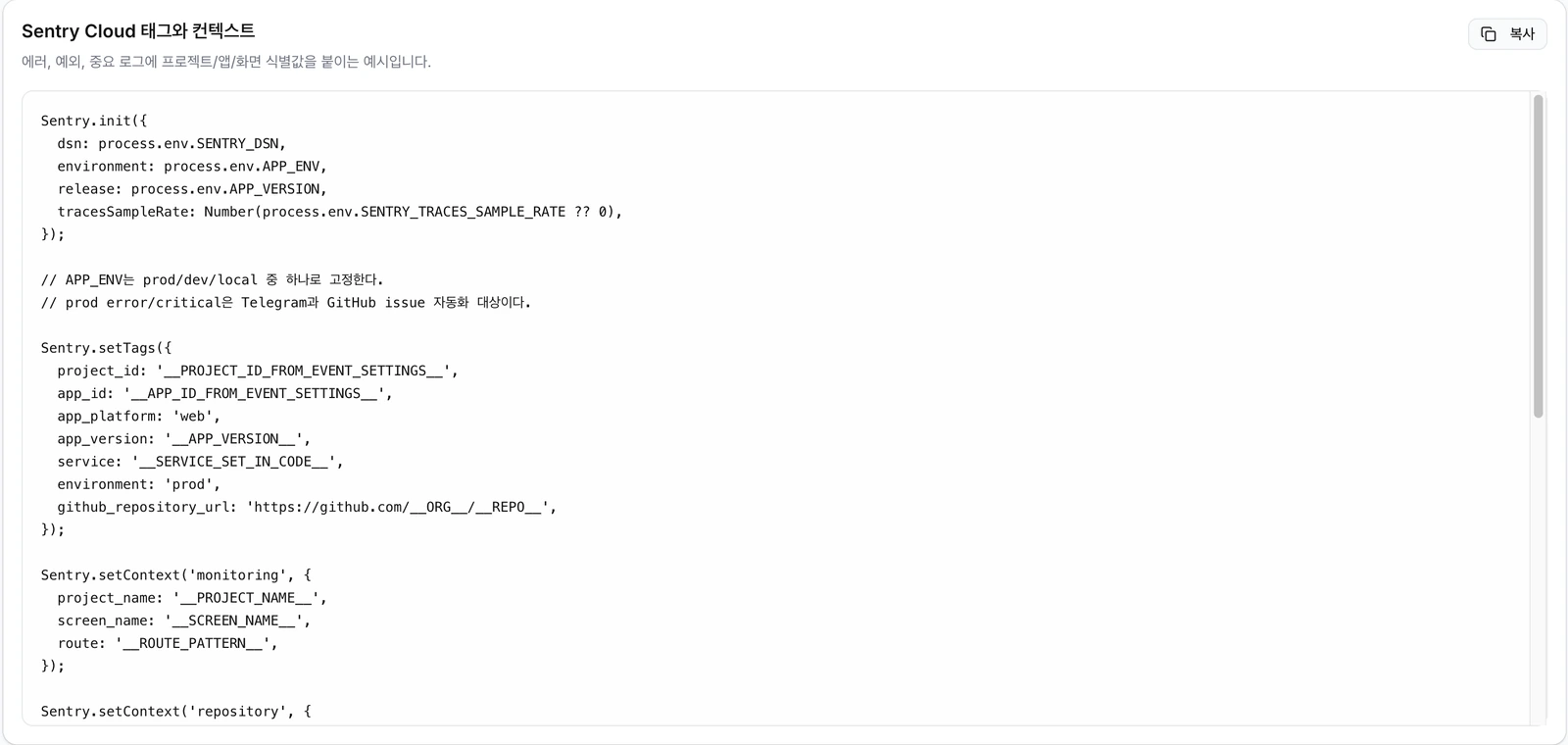
What Sentry does — it captures exceptions not just with a stack trace but with tags and context, groups the same error into a single “Issue,” and once it crosses a threshold, alerts and automates through Telegram / GitHub Issues. In other words, a failure that used to vanish into .catch(() => {}) becomes, via Sentry.captureException(error) plus tags, a searchable, alerting event. (This post’s cover is exactly that tag/context setup screen.)
Here’s what changed:
-
Replaced the empty
catchblocks in channel/DM message notifications with an observability helper — no more.catch(() => {})swallowing. -
Rejected promises and push
success = falseare recorded viasecureLogger.error. -
Partial failures in the FCM response (
failureCount > 0) are recorded viasecureLogger.warn— the common case where only some tokens fail is now observable. -
A missing Firebase Admin config now returns as a push failure in production — a config gap no longer slips silently into non-delivery.
Tag each failure with which project / app / screen / route it happened on, and a problem like “push fails only on one screen” gets narrowed down instantly in Sentry.
try { await runImportantAction();} catch (error) { Sentry.withScope((scope) => { scope.setLevel('error'); scope.setTag('screen_name', screenName); scope.setTag('route', route); scope.setContext('request', { method, endpoint, http_status, duration_ms }); Sentry.captureException(error); });}After moving to the queue, the only failure point left in the response path is the enqueue itself — and that one isn’t swallowed either:
enqueuePush(...).catch((err) => { secureLogger.error("push enqueue failed", err, { operation: "push.enqueue", messageId, event }); metrics.increment("push_enqueue_failed");});The spot where .catch(() => {}) used to fake “no error” is now the spot that records “what failed, and how.”
5. Why This Way — A Production Lens
Pulling push out of the request path into a queue, and making failures observable, isn’t a matter of taste; it’s essentially the standard in messaging services. The reasons map exactly onto the arguments behind this problem.
-
Isolating external I/O — FCM/APNs are external networks prone to latency and partial outages. That must not bleed into message-send TPS.
-
Fan-out amplification — one message expands to N recipients, which expands again to N push calls. The bigger the channel, the less the request can absorb it.
-
Retries and token hygiene — FCM recommends exponential backoff on failure, and dead tokens must be cleaned up continuously to keep delivery rates healthy. The request path can do neither.
-
Visibility of failure — push is a core retention channel. When Firebase has a partial outage, users miss notifications — and if that runs without a signal for days, that’s the real incident. Failures must be observable.
Conclusion
-
An empty
catchisn’t “no error” — it’s “no signal.” Swallow external I/O silently, and the signal you need most disappears exactly when it starts hurting. Moving to a queue and leaving failures in Sentry are one set, not two separate chores. -
A floating promise is not free async. Even after the response finishes, it survives in the same process and the same pool, eating resources. “I didn’t await it, so it’s unrelated to the request” is an illusion.
-
In the end, it was the same root as Part 2. The message-send handler was carrying data consistency (the deadlock), external I/O (push), and even failure observability all by itself. If Part 2 was the story of organizing DB responsibility with a transaction, Part 3 is the story of offloading external I/O to a worker and restoring visibility into its failures. Redrawing the boundary so the handler does only its own job (respond) — that’s the one sentence running through both parts.
Comments