
[Messenger Load-Testing, Part 2] There Was a Deadlock Hiding in AI-Generated Code — How We Replaced `unreadCount` with `lastReadAt`
42.8% HTTP error rate, 9 minutes into a load test, at 12% of the target TPS. The culprit was a single updateMany line written during AI-assisted coding.
On this page
- Introduction
- 1 Discovery
“Why are we doing 9.5 TPS when the target is 75?”
- 2 The Real Culprit
40P01 deadlock detected
- 3 Code Audit
Wait, We Do 4–5 Writes Per Message?
Direct Evidence From the PG Log - 4 Honest Confession
This Was an Embarrassing AI-Coding Mistake
- 5 Prescriptions on the Table
How Far Should We Go?
- 6 What We Picked
- 7 Migration Strategy
Don’t Flip Everything At Once
- Conclusion
Introduction
NOTE
42.8% HTTP error rate, 9 minutes into a load test. The culprit was a single updateMany line carelessly written during AI-assisted coding.
With the load-test environment from Part 1 now in place, it was finally time to measure how many TPS the send API could actually survive. The target was a modest 75 TPS of chat traffic. The moment the test started, the numbers fell apart — and this post is the story of tracking down why.
1. Discovery — “Why are we doing 9.5 TPS when the target is 75?”
We ran k6 against a load-test environment, targeting 75 TPS of chat traffic. The numbers came back ugly.
| Metric | Value |
|---|---|
| Target TPS | 75 req/s |
| Achieved TPS | 9.5 req/s (12% of target) |
| HTTP error rate | 42.8% |
| HTTP 5xx | 4.07 req/s |
| Postgres active connections | 11 / 27 max — plenty of headroom |
| Centrifugo publish failures | 0 |
The first suspect was always going to be connection pool exhaustion. But Postgres was only using 11 of 27 connections, and Centrifugo publish was 100% successful. Every signal pointed at the app server’s database queries themselves.
2. The Real Culprit — 40P01 deadlock detected
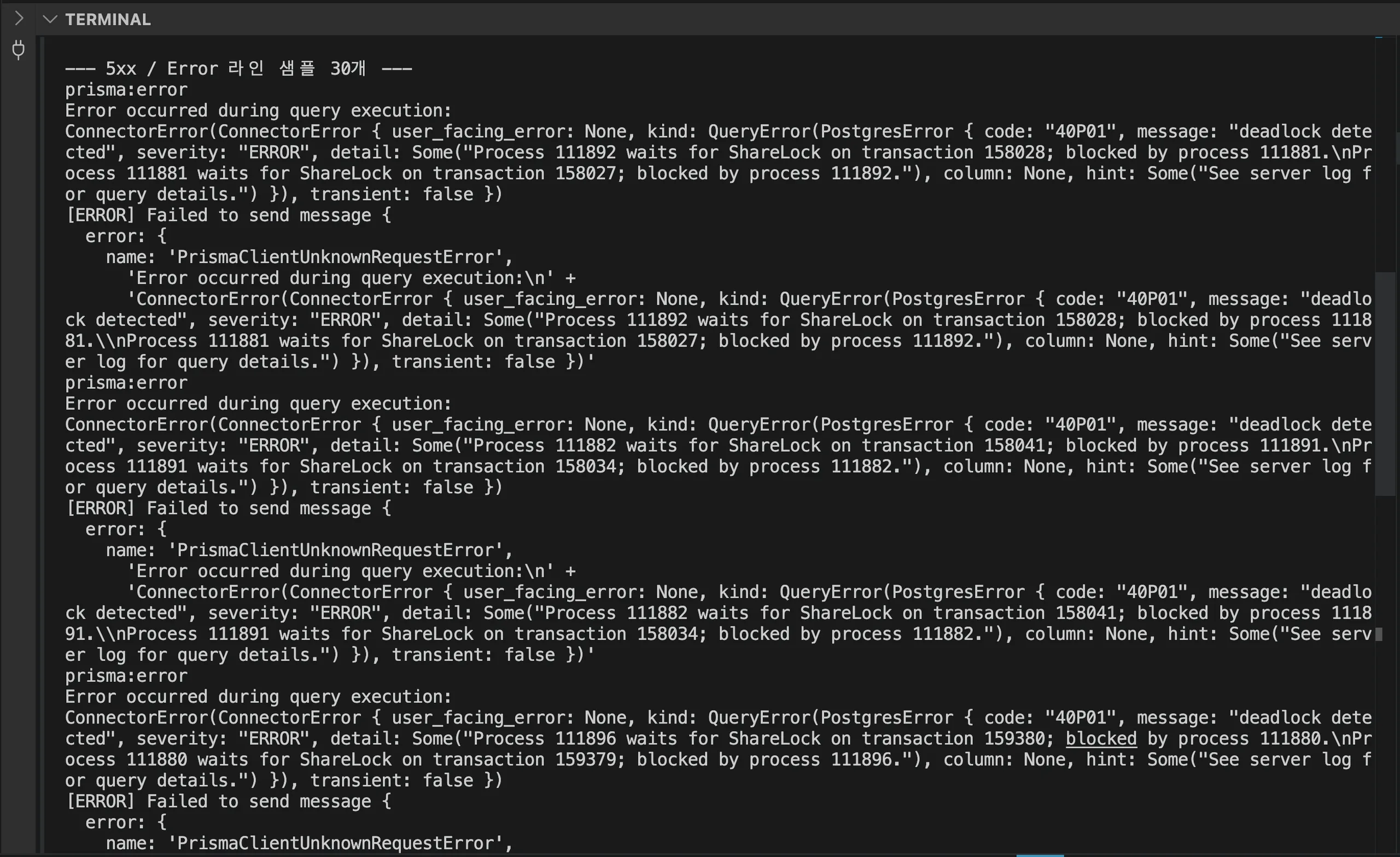
docker logs witim-web showed all the 5xx lines in identical shape:
prisma:errorError occurred during query execution:ConnectorError(... QueryError(PostgresError { code: "40P01", message: "deadlock detected", severity: "ERROR", detail: Some("Process 111892 waits for ShareLock on transaction 158028; blocked by process 111881. Process 111881 waits for ShareLock on transaction 158027; blocked by process 111892.")}))Not P2024 (pool timeout). Not ETIMEDOUT. Pure PostgreSQL row-lock deadlock. Sixteen concurrent transactions were locking the same set of rows in different orders and crashing into each other.
3. Code Audit — Wait, We Do 4–5 Writes Per Message?
The offending handler, POST /api/channels/[id]/messages, was doing four to five serial writes with no transaction wrapper:
| # | Operation | Lock impact |
|---|---|---|
| 1 | message.create (Message + Mention + Attachment nested) | Channel/User row KEY SHARE |
| 2 | message.update (parent.replyCount++) [reply only] | parent Message row exclusive |
| 3 | channel.update (updatedAt) | Channel row exclusive |
| 4 | channelMember.updateMany (others’ unreadCount++) | multiple ChannelMember rows exclusive ← deadlock vector |
| 5 | channelMember.updateMany (sender unreadCount=0) | sender ChannelMember row exclusive |
#4 is the killer. When users A and B send messages to the same channel concurrently:
Tx-A: UPDATE ChannelMember WHERE channelId=X AND userId != A → locks rows B, C, D, ... one at a time, in scan orderTx-B: UPDATE ChannelMember WHERE channelId=X AND userId != B → locks rows A, C, D, ... one at a time, in scan orderupdateMany is one SQL statement, but with no ORDER BY, Postgres picks lock order based on the plan. Cache state, parallel worker distribution, and table statistics all influence it — meaning the order can change between two concurrent executions of the same SQL.
Direct Evidence From the PG Log
Every deadlock had a different CONTEXT line:
| Time | CONTEXT |
|---|---|
| 05:28:46 | while updating tuple (44,45) |
| 05:28:54 | while updating tuple (105,19) |
| 05:28:55 | while updating tuple (89,28) |
| 05:29:09 | while locking tuple (214,56) |
| 05:29:10 | while locking tuple (1364,5) |
(page, slot) is different every time → lock order is non-deterministic. Hypothesis confirmed.
4. Honest Confession — This Was an Embarrassing AI-Coding Mistake
Let me come clean. This updateMany was generated during AI-assisted coding.
// Intent: "When a message is sent, bump unreadCount by 1 for every other member"await prisma.channelMember.updateMany({ where: { channelId, userId: { not: senderId } }, data: { unreadCount: { increment: 1 } },});Syntactically perfect. Works flawlessly in a single-channel, single-message, single-user test. PR review passed.
But it silently skipped two questions that should have been asked:
-
“Should we really write to N rows on every single message?” — A channel with 200 members means 200 row writes per message. 100 users sending = 20,000 writes/sec. At that volume, RDBMS row writes per message are structurally inefficient.
-
“What happens when two people post to the same channel at the same time?” — That’s the core usage pattern of any messaging app. The AI didn’t think about it. And neither did I when I merged the PR.
This is the AI-coding trap. Code that looks like it works lets you skip thinking about concurrency scenarios. Without the load test, this would have detonated in production the same way.
5. Prescriptions on the Table — How Far Should We Go?
The issue listed three tiers of fixes:
P0 (immediate):
-
Deadlock retry interceptor for
40P01 -
Rewrite
updateManyas raw SQL withORDER BY id FOR UPDATE→ deterministic lock order
P1 (short term):
- Move
unreadCountto Redis HINCRBY, periodically flushed to DB
P2 (medium term):
- Partition Message INSERTs by
channelIdhash
P0 alone makes the deadlock go away. But 1 message = N row writes stays. At 100K CCU, this will explode again — just in a different form.
P1 (Redis) is faster but introduces Redis ↔ Postgres synchronization complexity. unreadCount temporarily diverges from Postgres, and a failed Redis flush can permanently skew the count.
So we chose a different direction.
6. What We Picked — The lastReadAt Column
Core idea:
“Don’t write a counter on every message. Compute the count when you read.”
Drop the ChannelMember.unreadCount column. Replace it with a single ChannelMember.lastReadAt timestamp.
Before — write-heavy
[Send 1 message]  ├─ INSERT Message                              (write 1)  ├─ UPDATE ChannelMember unreadCount++ for N    (write N) ← deadlock vector  └─ UPDATE ChannelMember unreadCount=0 (sender) (write 1)
→ 1 message = (N+2) writes
After — read-on-demand
[Send 1 message]  └─ INSERT Message                              (write 1)                                                          ← done.
[Fetch channel list]  └─ SELECT count(*) FROM Message       WHERE channelId = $1 AND createdAt > lastReadAt   (read, hits index)
[Enter channel / mark as read]  └─ UPDATE ChannelMember SET lastReadAt = NOW()       WHERE userId = \(1 AND channelId = \)2              (write 1, own row only)
Why This Kills the Deadlock
updateMany WHERE userId != sender disappears. Sending a message no longer touches other users’ rows. The lock-contention vector is removed from the code entirely.
lastReadAt updates only touch your own row. User A only ever updates A’s ChannelMember row, user B only B’s. There is no scenario where two transactions compete for the same row — it’s eliminated by construction, not by retry logic.
Why This Isn’t a Performance Regression
At first glance, “running count(*) every time” sounds slower. It isn’t, because:
-
Reads are cache-friendly. With a composite index on
(channelId, createdAt), the count becomes an index range scan. -
Read frequency << write frequency. Users see the channel list when they open the app or enter a channel. Messages are sent dozens to hundreds of times per second. Moving N writes → 1 read is an enormous win on its own.
-
Reads can be served from a read replica. Write locks cannot.
Sequence Diagram (Conceptual)
[Before — count at write time]User A ─── POST /messages ───▶ Web                                 ├─ INSERT Message                                 ├─ UPDATE ChannelMember(N rows) ← 💥 deadlock                                 └─ 200 OK
[After — count at read time]User A ─── POST /messages ───▶ Web                                 ├─ INSERT Message                                 └─ 200 OK                       ← done
User B ─── GET /channels  ───▶ Web                                 ├─ SELECT channels ...                                 ├─ SELECT count(*) FROM Message                                 │    WHERE createdAt > lastReadAt                                 └─ [{ id, name, unread: 3 }, ...]
User B ─── POST /channels/X/read ▶ Web                                 └─ UPDATE ChannelMember                                      SET lastReadAt = NOW()                                      WHERE userId = B           ← own row only
7. Migration Strategy — Don’t Flip Everything At Once
Phased rollout for backward compatibility:
-
Phase 1: Add the
lastReadAtcolumn. Keep the existingunreadCountwrite path untouched. -
Phase 2: Switch only the read API to the new approach (
count(*) WHERE createdAt > lastReadAt). -
Phase 3: Re-run the load test. Confirm 75 TPS passes cleanly.
-
Phase 4: Delete the
unreadCountwrite code and drop the column.
By the end of Phase 2, the deadlock vector is already gone. Why? Once the read path is based on lastReadAt, a wrong unreadCount value is no longer visible to users. After that, we can clean up the write path on our own schedule, with no production pressure.
Conclusion
This incident wasn’t a one-line bug. It was a thinking-pattern trap.
-
The AI-generated
updateManyis a correct answer to “How do I express this in Prisma syntax?” -
It is not an answer to “In a messaging app, how does this SQL acquire locks when two users post to the same channel simultaneously?” Because nobody asked that question.
-
The faster AI-generated code lands, the more human review of concurrency, isolation, and scalability matters. That’s the actual value of a PR review.
One more lesson. Load testing belongs before production, not after. Without an isolated load-test environment, this would have detonated under 100K CCU traffic. We’d have been chasing a 5xx storm caused by deadlock cycles in production. The environment itself prevented one incident.
Comments